As we began discussing Web Hosting in class, I wondered to myself, “what did people do before sites like GoDaddy existed? How did they make a website?” Today, it is so easy to log on to GoDaddy or other platforms, and buy a domain name, or to open Wix and WordPress to create a website, but it makes me wonder what people did before that was an option.
For my last blog post I wanted to echo my post from last week and dive into the history of web hosting services. All of this information came from a great article on Dirox.com called “The Evolution of Web Hosting,” which I highly suggest reading if you are interested in learning more.
Web Hosting from 1990 – 2009
Tim Berners-Lee created the first website in 1991 at the European Organization for Nuclear Research. Because there were no web hosting providers, if you wanted to start a website, you needed to set up a server and connect it to the internet, which obviously was a very tedious process. I can’t even personally imagine what Berners-Lee must have been thinking, creating the first website and not having any precedent to follow.
What is even more remarkable to me, is that just four years later, Geocities launched the first web hosting service. The free hosting and storage space had many limitations, including “bandwidth limitations, security issues, and frequent downtime.” Despite these inconveniences, many people used the service and it grew in popularity, as did the overall demand for web hosting providers.
Because of this demand, shared hosting emerged, which is the process of multiple websites sharing the same server and resources, helping to lower the cost and complexity needed. The drawback to this is that if one site experiences issues, the other websites that share the server might also experience the same performance issues.
It wasn’t until the “Dot-Com Boom” of the 2000s that more reliable solutions emerged. It was during this time that e-commerce and content driven sites began to increase in popularity. Dedicated hosting was developed as a form of web hosting where each website has its own dedicated server, giving it complete access to all resources and the ability to customize them as needed. This also gives the site better performance, as well as increased security and reliability.
New Models of Hosting: 2010-2020
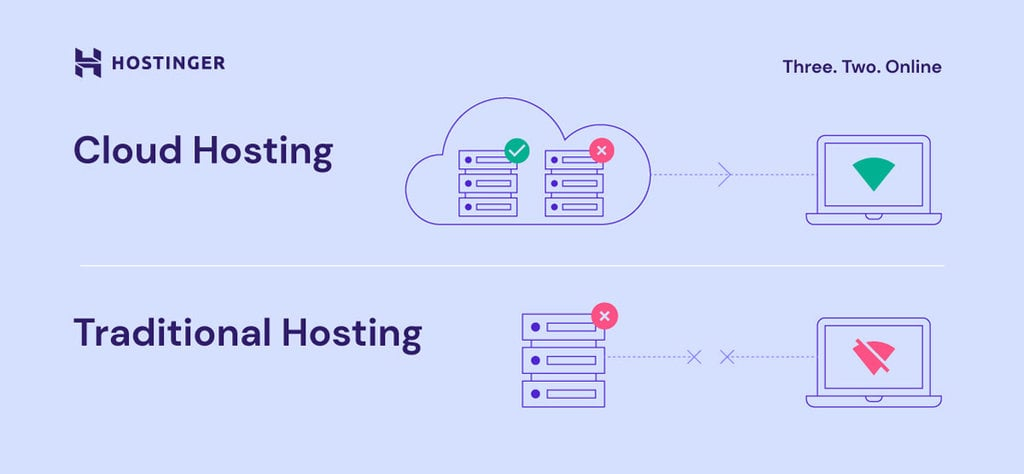
In the past ten years cloud hosting has surfaced, which is probably a term that sounds more familiar to you, as it echos all other cloud systems. Cloud hosting is where “a website is hosted on a network of servers that are connected via the internet.” This allows resources from multiple servers to be used at once, depending on the needs of each website. This model of hosting is a lot more scalable, flexibile and cost effective.
This graphic from the article helps to show the difference between traditional hosting and cloud hosting.
Looking Forward
The process of Web Hosting is by no means stagnant, and we will likely continue to see many new advancements and updates as our technology becomes more advanced, and as the need for greater storage and bandwidth increases. Some things to keep an eye on for the future of website hosting:
- AI- “could help optimize the server resources, and load balancing for websites” as well as improve overall website security and customer support.
- Green Hosting– “web hosting that aims to reduce the environmental impact of web hosting by using renewable energy soures and minimizing carbon emissions.” As concerns for environmental sustainability increase, how websites are hosted will likely evolve and shift.
Hopefully this blog post was helpful in explaining the evolution of website hosting, as well as painting a picture for the future of what this industry might hold.
2 Responses
This was a fascinating post! Often, times we get caught up with the current technology and tools we have and forget about where it came from. It was cool to see the difference between cloud and traditional hosting, neither of which I knew much about before your post. I am interested in seeing what the future of web hosting looks like in the years to come.
I’ve wondered about the history of web hosting too, since cloud hosting is the standard now, and it’s hard to imagine a time when anything more than buying a domain name was required. I also think green hosting will definitely be an area in which we’ll see a lot of growth in the next few years, hopefully with in increased sustainability in servers, etc. Great job!