Crumbl Cookies is a well-known franchise chain whose business model is based on fine-tuning a selective lineup of cookie recipes each week and selling them nationally for six days before introducing new flavors. With 950 locations across the US and more being added, launching and pulling their entire stock every week with only Sundays off to flip the store inventories is an impressive feat. Every store location carries the same flavors on any given week. Crumbl has used this strategy to form a community around their products, and resulted in the business reaching some level of virality around the time of its inception. Customers could talk about the cookies of the week and look forward to the next week’s together.
When Crumbl first started, it was fairly unique in its value proposition. There were certainly well-known dessert shop chains with carefully curated offerings, such as Nothing but Bundt, but there was no national cookie chain with branding anything like Crumbl’s. This meant that people who wanted to go buy a gourmet cookie would search for something like “cookies near me” instead of being able to put in the name of a cookie chain.
Crumbl took advantage of this and listed all of its franchise locations in the format of “Crumbl – Location” on Google Maps; for example, “Crumbl – Cranberry.” Today when users search for Crumbl, the stores populate on maps with the locations listed in the name.
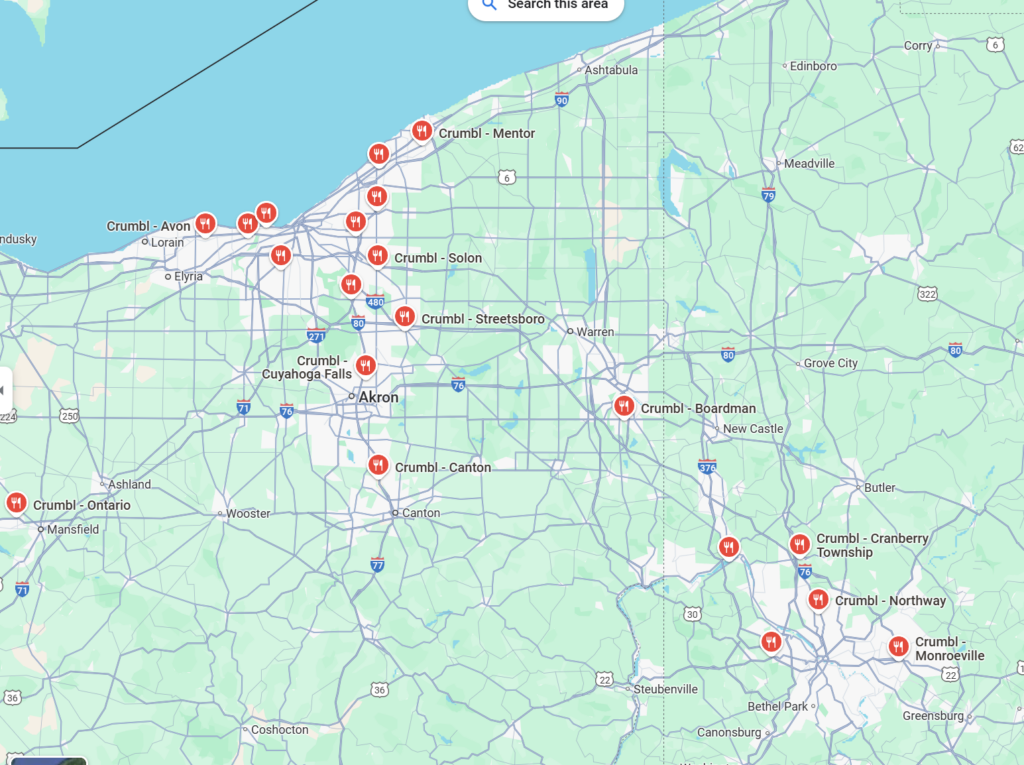
This strategy actually goes against Google’s recommendations for search engine optimization, even though it worked for Crumbl. This is because typically when customers search for things like “McDonald’s” or “gas near me”, the location information is not important enough to be listed in the name. McDonald’s can assume the user will find one nearby, and there are enough gas stations that someone would rather know where one is on a particular street rather than seeing a town name. However, even though it has rapidly expanded, Crumbl doesn’t have locations within a stone’s throw of each other like Starbucks or McDonald’s does, so providing a broader location helps users determine where the most convenient location might be.
If Crumbl continues expanding, they will probably consider taking locations out of their franchise names. For now, including this information is a smart technique to drive their search traffic from Google Maps to the actual Crumbl stores.
Catie Alexander
5 Responses
Hi Catie! I found your post to be very intriguing! We have a Crumbl not far from where I live, and I have found the idea of the company and the way it runs to be interesting! Having different flavors each week is a great technique for keeping a consistent customer base while also enticing more people to come in and try a cookie. It is interesting how the strategy that Crumbl uses goes against search engine optimization but works so well for them! Crumbl is not necessarily viewed as a necessary stop like Starbucks (coffee) or Sheetz (gas or food), so that would make sense why they do not need those almost convenience keywords. Crumbl seems to have a great grasp on who and how they find their audience. Great post!
Hi Katie, I never knew about crumbl’s strategy and I thought your blog post was very insightful to the very unique strategy that crumbl has employed. Also, I thought it was interesting that it was successful for them to go against Googles recommendation for SEO, by putting the location in the keyword. I feel that shows that crumbl really does know who they are and what the obstacles they face to try to be a successful business surrounded by massive restaurant chains that have stores everywhere. It shows that to be successful you have to be keen on what your customers may be thinking and needing to know about your business. Very cool post!
I really like your post! It is interesting to see how Crumbl goes against Google’s recommendations for search engine optimization, but their strategy has proven effective because of their limited number of locations and distance from one location to another. Their strategy to sell only a certain number of flavors each week, and change up those flavors every week, is certainly different from most other dessert places. It could end up working negatively for them if people decide not to buy because they don’t like the current week’s flavors. However, Crumbl has found a way to give people a unique cookie experience that brings people back over and over again! Nice work!
This was a really interesting case study of when including location as a modifier can benefit a company’s SEO efforts! Start-ups are definitely very dependent on advertising and SEO to reach new customers and become a household name. It’s clear they are serving a sweet spot that was previously missing and the strategy for including location is very clever!
Hey, Catie, I enjoyed reading your post. The title jumped out at me, and I had to read it. The business idea of Crumbl is genius, in my opinion. The idea of changing the product every week to get people coming and trying out new flavors that weren’t there the past week is very niche. Their strategy to use the location in their keywords is super interesting as well, and it paid off – look how successful it is! They are hitting a niche market using a niche modifier: their location. Good job, Catie!